
Year 8 Maths: Addition and Subtraction of Whole Numbers and Decimals
Year group: Year 8 (Key Stage 3) Topic: Addition and subtraction of whole numbers and decimals Difficulty: Foundation to intermediate
You can add and subtract without a calculator by lining up digits with the same place value. Work from right to left. The examples below show when to carry or exchange, and why decimal points must line up.
Watch the video lesson
This narrated Year 8 lesson is 3 minutes 20 seconds long. Watch the worked examples, then pause at the practice slide and try the four questions yourself.
Adding whole numbers
- Write the numbers in columns: ones under ones, tens under tens.
- Start at the right. Add the digits in each column.
- If a column totals 10 or more, write its ones digit and carry the extra ten to the next column.
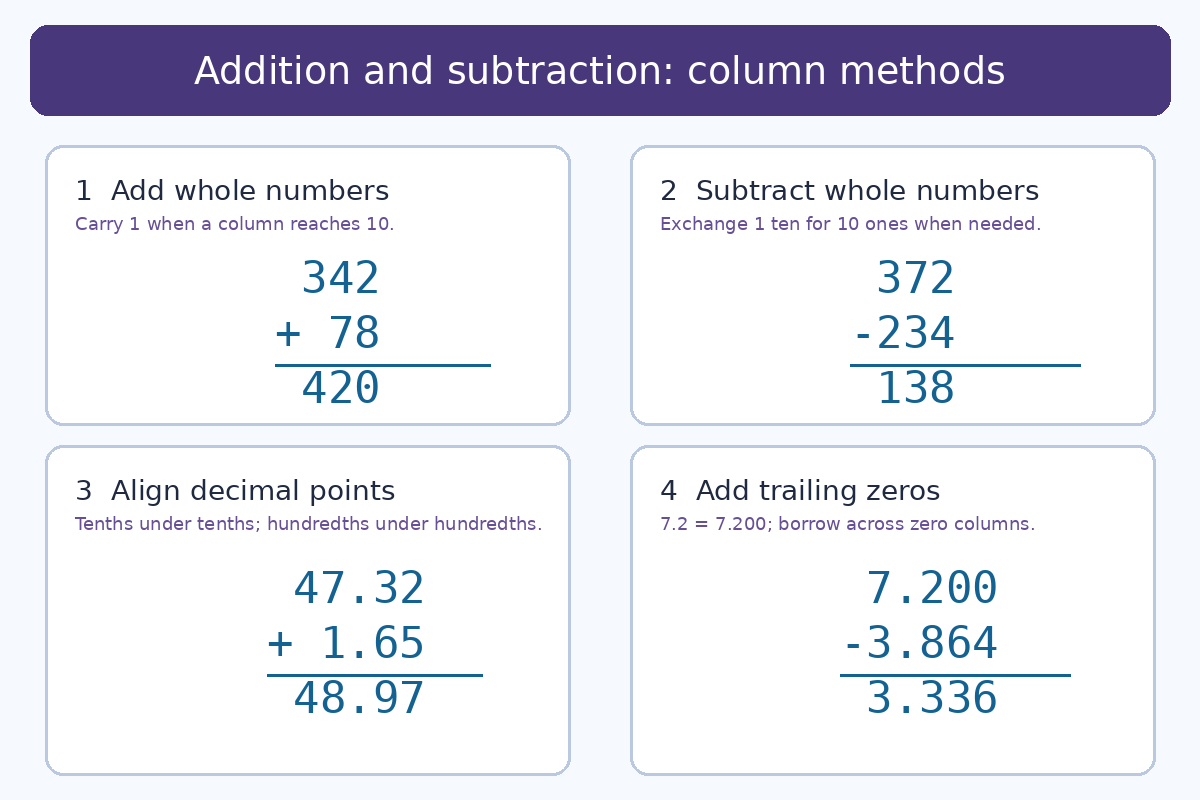
Worked example: 342 + 78. Ones: 2 + 8 = 10, so write 0 and carry 1 ten. Tens: 4 + 7 + 1 = 12 tens, so write 2 and carry 1 hundred. Hundreds: 3 + 1 = 4. Therefore 342 + 78 = 420.
Subtracting whole numbers
- Line up digits in the same place-value columns.
- Work from right to left.
- If the top digit is too small, exchange 1 from the column to its left for 10 in the current column.
Worked example: 372 − 234. Ones: 2 is smaller than 4, so exchange 1 ten. The ones become 12 and the tens become 6. Then 12 − 4 = 8; 6 − 3 = 3; and 3 − 2 = 1. Thus 372 − 234 = 138. Check: 138 + 234 = 372.
Adding and subtracting decimals
The method is the same: line up the decimal points, so tenths are under tenths and hundredths under hundredths. You can write extra zeros at the end: 7.2 = 7.200.
Worked example: 47.32 + 1.65. Hundredths: 2 + 5 = 7. Tenths: 3 + 6 = 9. Ones: 7 + 1 = 8. Tens: 4 remains. Therefore 47.32 + 1.65 = 48.97.
Worked example: 7.2 − 3.864. Write 7.2 as 7.200. Exchange across the zeros: 10 thousandths − 4 = 6; 9 hundredths − 6 = 3; 11 tenths − 8 = 3; 6 ones − 3 = 3. Thus 7.200 − 3.864 = 3.336. Check: 3.336 + 3.864 = 7.200.
Before you finish
- Estimate: 47.32 + 1.65 is about 47 + 2 = 49, close to 48.97.
- For subtraction, add the answer to the smaller number to check.
- For money and measurements, include the correct unit in your answer.
Practice questions
Try these 15 original questions without a calculator. Write out columns for questions 1–10. Worked answers are in the separate section below.
- 342 + 78
- 568 + 247
- 903 + 89
- 372 − 234
- 604 − 278
- 1000 − 456
- 47.32 + 1.65
- 3.47 + 2.8
- 0.086 + 1.35
- 7.2 − 3.864
- 8.3 − 2.57
- 5.004 − 0.86
- A book costs £7.85 and a pen costs £1.65. What is their total cost?
- A ribbon is 12.5 m long. You cut off 3.75 m. How much remains?
- Fill the missing digit: 6.□8 + 1.45 = 8.13.
Worked answers
Check your method after attempting the questions.
- 342 + 78: 2 + 8 = 10 (carry 1); 4 + 7 + 1 = 12 (carry 1); 3 + 1 = 4. 420.
- 568 + 247: 8 + 7 = 15 (carry 1); 6 + 4 + 1 = 11 (carry 1); 5 + 2 + 1 = 8. 815.
- 903 + 89: 3 + 9 = 12 (carry 1); 0 + 8 + 1 = 9; hundreds 9. 992.
- 372 − 234: exchange one ten; 12 − 4 = 8, 6 − 3 = 3, 3 − 2 = 1. 138.
- 604 − 278: exchange one hundred into tens, then one ten into ones; 14 − 8 = 6, 9 − 7 = 2, 5 − 2 = 3. 326.
- 1000 − 456: exchange across the zero columns; 10 − 6 = 4, 9 − 5 = 4, 9 − 4 = 5. 544.
- 47.32 + 1.65: decimal points aligned; 2 + 5 = 7 hundredths, 3 + 6 = 9 tenths, 47 + 1 = 48. 48.97.
- 3.47 + 2.80 = 6.27.
- 0.086 + 1.350 = 1.436.
- 7.200 − 3.864 = 3.336. Check: 3.336 + 3.864 = 7.200.
- 8.30 − 2.57 = 5.73. Check: 5.73 + 2.57 = 8.30.
- 5.004 − 0.860 = 4.144.
- £7.85 + £1.65: 85p + 65p = 150p = £1.50; £7 + £1 + £1.50 = £9.50.
- 12.50 − 3.75 = 8.75 m. Check: 8.75 + 3.75 = 12.50.
- Hundredths: 8 + 5 = 13, so carry 1 tenth. Tenths: □ + 4 + 1 = 11, so □ = 6. Check: 6.68 + 1.45 = 8.13.
Original explanations, illustration, practice questions, and answers for Year 8.

Leave a Reply